
Arkansas’ Ten Commandments Monument Is Constitutional
Jul 30, 2026
Liberty Counsel filed an amicus brief in Cave v. Jester urging the U.S. Eighth Circuit Court of Appeals to uphold Arkansas’ 2015 Ten Commandments Monument Display Act and allow a monument of the Decalogue to remain displayed on Capitol grounds.
Liberty Counsel argues that the district court ruling blocking the law should be reversed because it relied on abandoned Establishment Clause precedent from Lemon v. Kurtzman, which was overruled in 2022.
Liberty Counsel filed the brief on behalf of the National Association of Christian Lawmakers, an association of Christian elected officials, and the American History and Heritage Foundation, which donated Arkansas’ Ten Commandments monument.
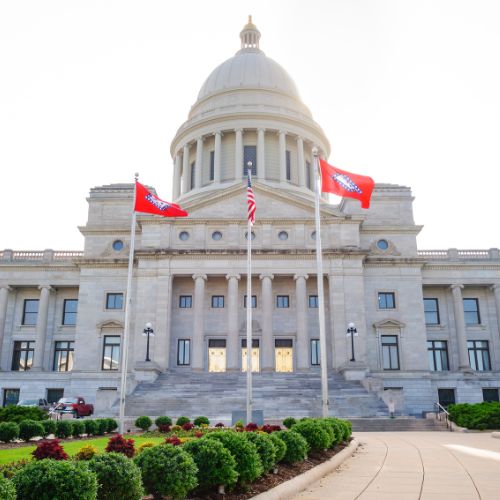
In March 2026, a federal district court ruled the state’s Ten Commandments monument violated the First Amendment Establishment Clause and ordered the state to remove the privately donated, 6,000-pound granite display from Capitol property. The court’s ruling is in a lawsuit against the state’s Display Act brought by plaintiffs from organizations including the Humanist Association, the Freedom from Religion Foundation, the Arkansas Society of Freethinkers, and the Satanic Temple.
In 1971, the U.S. Supreme Court created the “Lemon Test” in Lemon v. Kurtzman to determine if a law violated the Establishment Clause, which had since been used to unnecessarily censor religious speech, symbols, and displays in the government sphere. Under the “Lemon” framework, courts often determined displays of the Ten Commandments as having an intent to primarily promote religion rather than having a genuine historical or educational purpose. As the brief notes, the Supreme Court used the “Lemon Test” to declare government displays of the Ten Commandments unconstitutional in Stone v. Graham (1980) and McCreary County v. ACLU (2005). However, SCOTUS abandoned the “Lemon Test” in a series of more recent rulings, such as American Legion v. American Humanist Society (2019), Liberty Counsel’s 9-0 victory in Shurtleff v. City of Boston (2022), and Kennedy v. Bremerton School District (2022), whereby the analysis of religious displays is now controlled by history and tradition—a reference to the Founding-era understanding of religious establishment.
“American Legion was strike one. Shurtleff was strike two. Kennedy was strike three,” reads the brief. “Here, Arkansas’s Display Act bears no resemblance to a founding-era religious establishment because it does not coerce anything. Arkansas merely decided to place the donated Ten Commandments monument on its Capitol grounds ‘for ceremonial, celebratory, or commemorative purposes,’ and is therefore presumed constitutional.”
Liberty Counsel contends the Arkansas display is simply a historical display with a secular purpose and does not resemble a religious establishment since the passive monument does not compel religious observance, nor does the state punish dissenters, require residents to fund a church, or otherwise exhibit the historic hallmarks of religious coercion.
Courts have recognized that American law and western tradition have been “founded on the Decalogue,” and government’s recognition of the role of the Ten Commandments in the nation’s heritage does not violate the Establishment Clause as the Founders understood it, concluded Liberty Counsel.
Cave v. Jester is one of two Ten Commandments cases currently in the Eighth Circuit. The other case is Stinson v. Arkansas, which challenges Arkansas’ Senate Bill 433 (Act 573) that pertains to displaying posters of the Ten Commandments in every school “library and classroom.” Liberty Counsel has also filed a similar amicus brief in this case urging the court to uphold the posting of the Ten Commandments in public school classrooms.
Liberty Counsel’s Founder and Chairman Mat Staver said, “The Ten Commandments Monument Display Act neither establishes a state religion nor coerces religious activity. Instead, it passively commemorates the Decalogue’s historical significance which fits squarely under the Constitution. There are about 50 displays of the Ten Commandments inside and outside the United States Supreme Court and a prominent display at the Library of Congress and on the floor of the National Archives. Arkansas’ law needs to be evaluated under the U.S Supreme Court’s ‘history and traditions’ framework where religious content does not equal coercion, and the lower court decision should be reversed and the monument allowed to freely stand.”
Liberty Counsel advances religious liberty, the sanctity of human life, and the family through litigation and education. We depend on your support, which enables us to represent people at no cost. Click here to GIVE NOW.

TAKE ACTION


Post Office Box 540774
Orlando, FL 32854
(407) 875-1776
Contact: LEGAL HELP
Contact: Other Issue/Question
Name
Choose Password
SIGN UP TO STAY INFORMED!
Liberty Counsel is a 501(c)(3), tax-exempt nonprofit organization. Contributions are tax-deductible to the extent permitted by law.
View our Privacy Policy.
©Copyright 1995 - present. All Rights Reserved.


